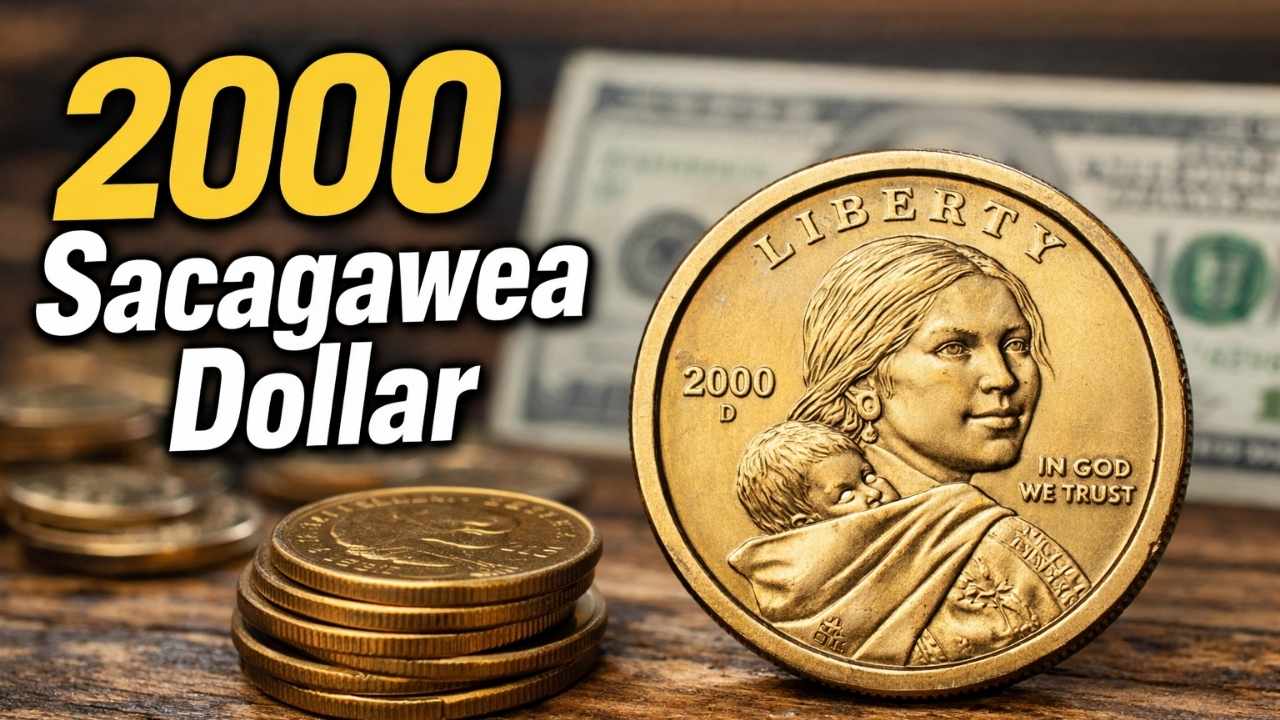
Rare 2000 Sacagawea Dollar: The Sacagawea Dollar, first released in 2000, was intended to be a bold new chapter in American coinage. With its golden hue and depiction of Sacagawea carrying her infant son, it stood out from the traditional silver-colored coins. While the coin itself was not widely embraced in everyday commerce, it quickly became a favorite among collectors. What makes the 2000 Sacagawea Dollar especially fascinating is the range of hidden errors and varieties that have surfaced over the years, turning ordinary pocket change into potential treasures.
The Birth of the Sacagawea Dollar
The United States Mint introduced the Sacagawea Dollar to replace the Susan B. Anthony Dollar, which had failed to gain popularity. The new coin was designed to be visually distinct, with a golden color achieved through a manganese brass composition. Glenna Goodacre’s design of Sacagawea with her child was praised for its artistry and symbolism. Yet, despite the Mint’s efforts, the coin struggled to circulate widely. Collectors, however, quickly noticed that some coins carried unusual traits that made them far more valuable than their face value.
The Cheerios Dollar Discovery
One of the most famous varieties is the “Cheerios Dollar.” In 1999, the Mint partnered with General Mills to promote the new coin by placing 5,500 examples in Cheerios cereal boxes. These coins were later discovered to have a different reverse design. The eagle’s tail feathers were more detailed compared to the standard issue. This subtle difference transformed the Cheerios Dollar into a highly sought-after rarity, with values reaching thousands of dollars depending on condition.
The Mule Error Coin
Perhaps the most dramatic error associated with the 2000 Sacagawea Dollar is the “Mule Error.” A mule coin is created when two mismatched dies are accidentally paired during minting. In this case, a Sacagawea Dollar obverse was struck with a Washington Quarter reverse. The result was a coin with George Washington’s portrait on one side and the Sacagawea reverse on the other. Only a small number of these coins were produced, making them incredibly rare and valuable. Some examples have sold for tens of thousands of dollars at auction.
The Goodacre Presentation Dollars
Another notable variety is the Goodacre Presentation Dollar. Glenna Goodacre, the artist behind the coin’s design, was paid her commission in 5,000 specially struck Sacagawea Dollars. These coins were produced with a distinctive finish, giving them a unique appearance compared to regular circulation strikes. Collectors prize these coins not only for their rarity but also for their direct connection to the coin’s creator.
Striking Errors and Planchet Flaws
Beyond the famous varieties, there are numerous striking errors and planchet flaws that make certain 2000 Sacagawea Dollars unique. Off-center strikes, double strikes, and coins struck on defective planchets have all been documented. While these errors may not reach the astronomical values of the Cheerios or Mule varieties, they still command strong interest among collectors who specialize in error coins.
The Role of Condition and Grading
As with all collectible coins, condition plays a crucial role in determining value. Coins graded by professional services such as PCGS or NGC often fetch higher prices, especially when they are in mint state or proof condition. Even common Sacagawea Dollars can gain value if they are preserved in pristine condition. For rare varieties, top grades can multiply their worth significantly.
Collector Demand and Market Trends
The market for Sacagawea Dollars has remained steady, with particular spikes in interest whenever new varieties or discoveries are reported. The Cheerios Dollar and Mule Error coins continue to be headline attractions at auctions. Meanwhile, presentation pieces and unusual errors maintain a loyal following. Collectors often view these coins as both historical artifacts and investment opportunities.
Identifying Hidden Treasures
For collectors hoping to find hidden treasures among Sacagawea Dollars, careful examination is key. Checking the reverse design for the detailed tail feathers of the Cheerios Dollar, inspecting for mismatched die strikes, and looking for unusual finishes can reveal valuable varieties. Even coins found in circulation may hold surprises, though most rarities are discovered in collections or through specialized dealers.
The Legacy of the 2000 Sacagawea Dollar
The 2000 Sacagawea Dollar represents more than just a coin. It embodies a moment in American numismatic history when innovation met tradition. While the coin did not achieve widespread use in commerce, its hidden errors and varieties ensured its place in the collector’s world. From cereal box promotions to minting mishaps, the Sacagawea Dollar continues to captivate those who appreciate the unexpected stories behind everyday objects.
Conclusion
The rare errors and varieties of the 2000 Sacagawea Dollar highlight the unpredictable nature of coin production and the excitement of collecting. Whether it is the Cheerios Dollar with its distinctive tail feathers, the astonishing Mule Error, or the Goodacre Presentation pieces, these coins remind us that even modern issues can hold remarkable secrets. For collectors, the thrill lies not only in owning these treasures but also in the hunt itself. The 2000 Sacagawea Dollar may have struggled in circulation, but in the world of numismatics, it remains a golden icon of rarity and intrigue.