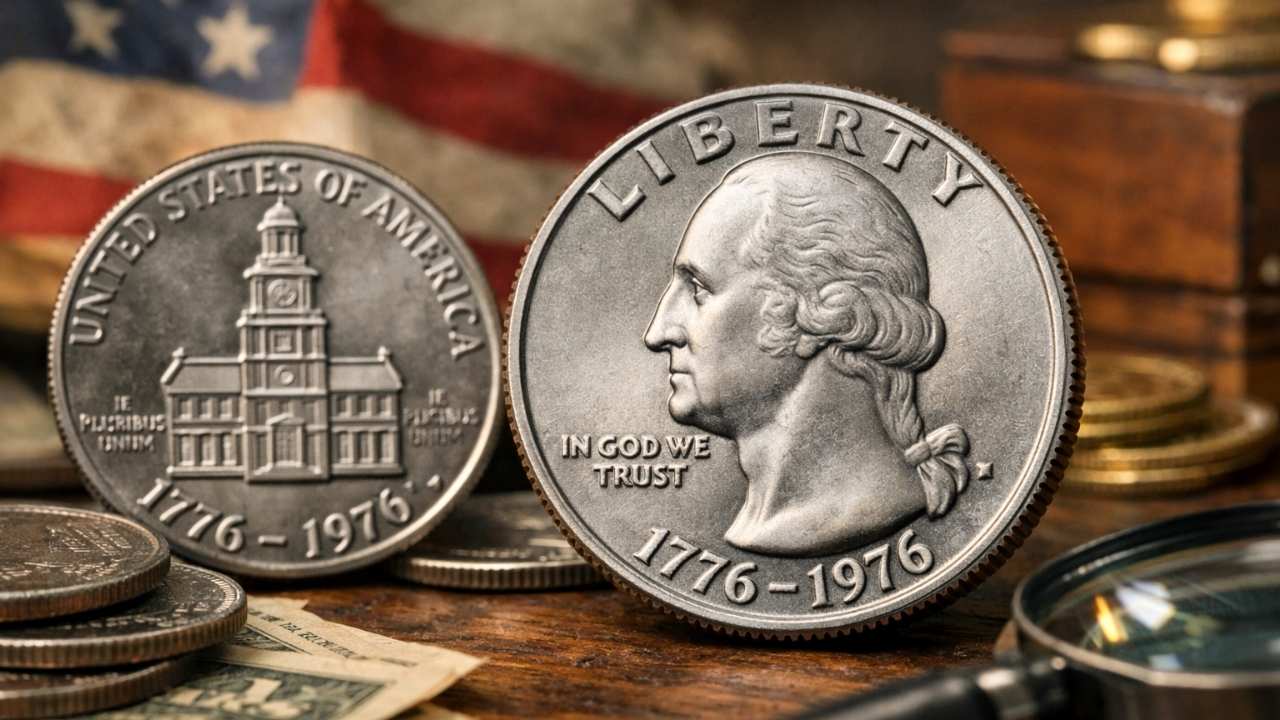
1776–1976 Bicentennial Quarter Value in 2026: The Bicentennial Quarter was introduced in 1975 and 1976 to commemorate the 200th anniversary of American independence. It was part of a larger program that included special designs for the half dollar and dollar. The quarter features the dual date 1776 and 1976 on the obverse, along with George Washington’s familiar portrait. On the reverse, a colonial drummer designed by Jack L. Ahr replaced the traditional eagle. This patriotic imagery captured the spirit of the bicentennial celebrations and made the coin instantly recognizable.
How Many Were Minted
The United States Mint produced hundreds of millions of Bicentennial Quarters, both in Philadelphia and Denver. Because of this massive mintage, most examples remain common today. Circulating coins are easy to find in pocket change, and even uncirculated rolls are still available from dealers. The sheer volume of coins struck means that most Bicentennial Quarters are worth only face value unless they are in pristine condition or have unusual characteristics.

Collector Interest in 2026
Fifty years after their release, Bicentennial Quarters continue to attract collectors. In 2026, interest has grown again because of the 250th anniversary of American independence. This renewed attention has led to higher demand for top-quality coins and rare varieties. Collectors are particularly drawn to coins graded by professional services, as certification provides assurance of authenticity and condition. High-grade examples, especially those with deep cameo proof finishes, are commanding strong prices in auctions and private sales.
Standard Values in Circulation
Most circulated Bicentennial Quarters are worth between twenty five cents and one dollar. Coins with light wear may sell for slightly more, but the majority remain inexpensive. Uncirculated examples in mint state grades can range from two to five dollars depending on luster and strike quality. Proof coins, which were sold directly to collectors in sets, often bring five to fifteen dollars depending on condition. Silver proof versions, struck in 40 percent silver, are more desirable and can sell for ten to thirty dollars.

Rare Errors That Increase Value
While most Bicentennial Quarters are common, certain error coins are highly sought after. These mistakes occurred during the minting process and created unusual varieties that collectors prize. Some of the most notable errors include double die obverse coins, off center strikes, and coins struck on the wrong planchet. A double die obverse may show doubling in the date or lettering, making it visually distinctive. Off center strikes can range from minor misalignments to dramatic shifts where part of the design is missing. Wrong planchet errors, such as a quarter struck on a dime blank, are extremely rare and can sell for hundreds or even thousands of dollars.
The Role of Grading
Grading plays a crucial role in determining the value of Bicentennial Quarters. Coins are evaluated on a scale from poor to perfect mint state. A coin graded MS65 or higher is considered gem quality and will command a premium. Proof coins are also graded, with deep cameo examples being the most desirable. Collectors in 2026 are paying close attention to grading, as even small differences in condition can lead to significant changes in value. For example, a Bicentennial Quarter graded MS67 might sell for fifty dollars, while an MS68 example could reach several hundred.
Auction Highlights in 2026
Recent auctions have demonstrated the strong demand for rare Bicentennial Quarters. High grade silver proofs have sold for several hundred dollars, while rare error coins have reached into the thousands. One notable sale included a double die obverse quarter graded MS66 that brought over three thousand dollars. Another auction featured an off center strike that sold for nearly two thousand. These results show that while most Bicentennial Quarters remain inexpensive, rare varieties can achieve impressive prices.
Investment Potential
For collectors considering investment, Bicentennial Quarters offer both challenges and opportunities. Common coins are unlikely to appreciate significantly, as supply remains abundant. However, rare errors and high grade examples have shown steady growth in value. The key is to focus on quality and rarity rather than quantity. Collectors who acquire certified coins with unique characteristics are more likely to see long term appreciation. As the 250th anniversary of American independence continues to spark interest, demand for these coins may remain strong throughout 2026.
Tips for Collectors
Those interested in collecting Bicentennial Quarters should keep several tips in mind. First, examine coins carefully for signs of wear, damage, or cleaning, as these factors reduce value. Second, consider purchasing certified coins from reputable grading services to ensure authenticity. Third, be aware of common varieties versus rare errors, as the latter hold far greater potential. Finally, enjoy the historical significance of the coin, as collecting is not only about value but also about preserving a piece of American heritage.
The Legacy of the Bicentennial Quarter
The Bicentennial Quarter remains a beloved coin fifty years after its release. It symbolizes a moment of national pride and celebration, and its design continues to resonate with collectors and the public alike. While most examples are common and inexpensive, rare errors and high grade coins provide excitement and value for numismatists. In 2026, as America marks its 250th anniversary, the Bicentennial Quarter stands as a reminder of the nation’s enduring history and the role coins play in commemorating it.

Conclusion
The 1776–1976 Bicentennial Quarter is more than just pocket change. It is a symbol of American independence, a collectible with enduring appeal, and in rare cases, a valuable treasure. In 2026, collectors are paying close attention to condition, rarity, and errors, driving strong prices for exceptional examples. Whether you hold a simple circulated coin or a rare proof error, the Bicentennial Quarter connects you to a pivotal moment in history and continues to inspire fascination fifty years later.